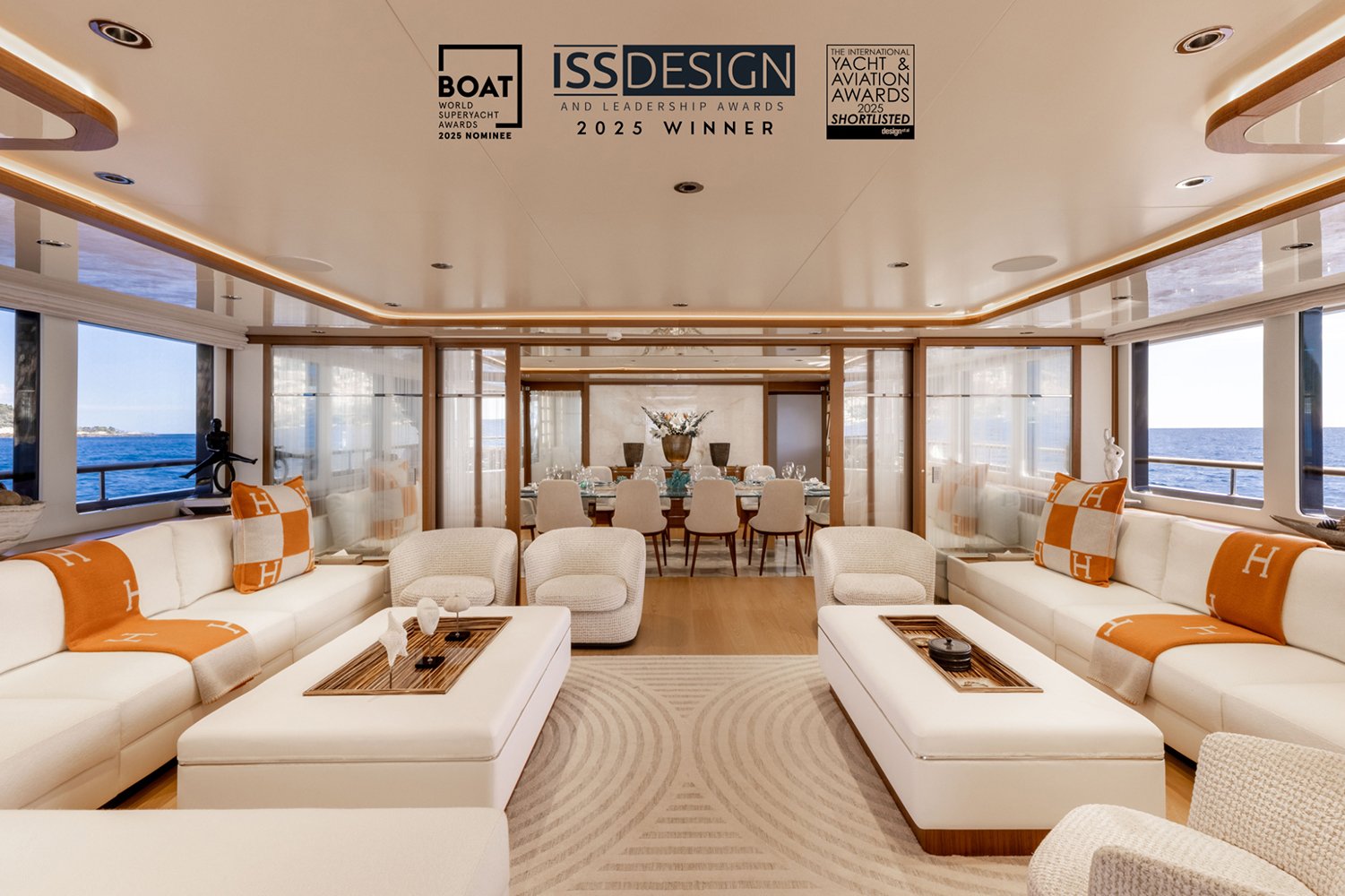
In this interview, we step into the world of Giulia Grassi, the visionary founder of Supernova Design. Through her words, we uncover the personal experiences and values that have guided her journey, a narrative shaped by a remarkable family legacy and a passion for innovation. Giulia’s reflections provide not only inspiration but also a glimpse into the foundations of her creative philosophy. She is going through this journey alongside her younger siblings.
As the conversation unfolds, Giulia opens up about the intricacies of her craft, revealing the thought and precision behind her designs. Navigating cultural influences to master the unique demands of yacht interiors, she offers insights that highlight both the artistry and technical expertise required in this field. Her story and work embody a blend of heritage, creativity, and vision, making this a truly engaging and enriching read. The studio is also involved in residential projects abroad, including in the UAE,Asia and the USA, catering to clients who want their homes to reflect the same quality, attention to detail, and aesthetic as their super yachts.
Q:Giulia your grandfather, Angelo Gallicchio, was a visionary whose work spanned continents and cultures. Growing up surrounded by his legacy, how did his influence shape your view of design and creativity?
Our grandfather Angelo was truly a visionary and our main source of inspiration from birth. At 18,he left a small town in Southern Italy with nothing but his talent for drawing. In Uruguay, he established his own factory within a few years, later moving to Los Angeles, where he entered Hollywood’s world, furnishing homes of stars like Elvis Presley aand Liberace. Eventually, he settled on Lake Como, working with clients from the UAE on projects like the Kuwait Palace, before moving to Monte Carlo. His exposure t o various cultures deeply influenced him and, by extension, us .
As children, we visited his studio often. I vividly recall his drafting table, now carefully preserved in our studio. He put pencils in our hands and encouraged us to draw. These moments taught us the value of passion, adaptability, and embracing international perspectives. We like to say we’re citizens of the world, thanks to his legacy.
Q:Designing for Hollywood stars and furnishing the Kuwait Palace, your grandfather’s work merged Eastern and Western aesthetics. How do you see that legacy reflected in your approach to design today?
Our grandfather’s ability t o integrate Eastern and Western aesthetics has deeply shaped our design philosophy. Each project is an opportunity to create a dialogue between cultures. For example, we recently designed a yacht interior for a multicultural family, seamlessly blending formal entertaining areas with relaxed, family-friendly spaces. By respecting cultural nuances and personal preferences, we create environments that are both functional and emotionally resonant. This synthesis allows us to craft experiences, not just spaces, honoring our grandfather’s legacy of customization and harmony.
Q:Your childhood in Monaco exposed you to a world of luxury and yachting. What was it about this environment that drew you to yachts specifically?
My childhood in Monaco immersed me in a world of luxury and yachting, where refinement and excellence are a part of everyday life. Growing up in this environment ignited in me a deep passion for design and naval architecture, particularly for yachts, which are true masterpieces of engineering and design. What has always captivated me about yachts is the challenge of creating a space that is not only aesthetically flawless but also functional and comfortable, often in extreme conditions. I still vividly remember how, as a child, I couldn’t wait to visit Monaco and go to the harbor every day with my grandfather. I was in awe of the beauty of the yachts, and it was there that I realized there was something even more extraordinary to aspire to: designing them. It’s truly wonderful to see how an idea, starting from a blank sheet of paper, can become a reality in the form of a magnificent yacht.
Q:Heritage often extends beyond design; it’s about values and philosophies. What is the most important lesson your grandfather taught you about design or life?
‘Don’t Worry’ he lived by that mantra. Every problem has a solution if you stay calm. Another lesson was his insistence on aiming for the extraordinary. Simple is easy, but extraordinary requires heart. To this day, I strive to create the extraordinary, especially in yachts.
Q:What does “heritage” mean to you, both personally and professionally? Is it a source of strength or a challenge to constantly live up to?
Heritage is both a strength and a challenge. Personally, I’m proud of my grandfather’s journey from humble beginnings to remarkable achievements. Professionally, it motivates me t o honor his legacy while striving to innovate. One pivotal moment was completing my first major yacht project, feeling the connection to his craftsmanship and innovation. Heritage reminds me to constantly improve and reach new heights, just as he taught us. I’ve been fortunate to have unwavering family support. They expected this step, as my sister and I always planned to open our own studio. By the time I founded Supernova, I felt ready. This moment was a culmination of preparation and passion instilled since childhood.
Q:Your refit of Yacht SOLAFIDE i s a perfect example of blending cultural influences. What was the brief from the client, and how did their traditions and customs shape the project?
The refit of MY SOLAFIDE, a 52-meter Benetti, was driven by the client’s request for flexible spaces t o accommodate a large family. Initially, it was about modernizing certain areas, but as the project progressed, we reimagined t h e entire layout. Inspired by the client’s Indonesian cultural values, we created multifunctional spaces, like a dining area large enough for the whole family, that combined timeless elegance with functional adaptability.
Q:Indonesian culture places a strong emphasis on family and tradition. How did you design the yacht’s spaces to reflect these values while maintaining the elegance expected of a Benetti yacht?
To honor the client’s emphasis on family, we restructured spaces to maximize seating and communal areas. For instance, the dining area was expanded to fit the entire family comfortably. In the living area, custom-designed sofas doubled as tables, enhancing functionality. On the upper deck, we created a lounge convertible into a VIP room with adaptable beds, reflecting the family’s traditions while maintaining the yacht’s refined aesthetic.
Q:What were the biggest challenges in transforming the yacht to meet the specific needs of the client and their family? How did you overcome them?
One of the biggest challenge was during the shipyard phase, when we were reworking the internal paneling and ceiling structures. We had to find various solutions to gain even just a few extra centimeters, always taking into account the onboard systems. In the end, we managed to create more space both in width and height, which was very important to the client. Another challenge was designing the spaces to be highly flexible. For the client, it was essential to have not only a beautiful design but also one that was very functional. As we know, achieving both aspects can often be difficult because highly functional features are not always aesthetically pleasing, and viceversa. It was a real challenge to design furniture and elements that were both visually stunning and practical, but I believe the final result is very successful…
Q:Your work often merges Eastern and Western influences. What are the most rewarding aspects of bridging these two worlds through design?
The most rewarding aspect of merging Eastern and Western influences in design is the creation of unique synergies that result in truly one-of-a kind projects. Each culture brings its own perspectives, traditions, and design principles, and combining these elements leads to an enriched final product that wouldn’t have been possible by adhering to just one approach. Eastern design often emphasizes harmony, spirituality, and connection t o nature, while Western design tends to focus on innovation, functionality, and bold aesthetics. Bridging these two worlds allows us t o take the best of both and
create something that resonates deeply with people on multiple levels-emotionally, culturally, and visually.
Q:Supernova’s philosophy emphasizes creating spaces that resonate deeply with the people who inhabit them. How do you ensure that every design feels personal and unique?
This aspect i s very important to us because, while we are the ones designing the space, it’s ultimately the client who will live in it. This i s why building a strong relationship with the client is the key to our process. Often, we work with clients who have a very clear vision of what they want and how they plan to use the space. Other times, we encounter clients who are not sure of what they’re looking for o r what they need. That’s why it’s crucial for us to understand them and, in many cases, help them discover their own desires and preferences for the space. A designer isn’t just someone who knows how to draw or has good taste. In my opinion, a designer must be skilled in many areas, and in our case, having the ability to truly understand our clients is fundamental. It’s only through this understanding that we can create spaces that make them happy and ensure each design feels deeply personal and unique.
Q:Finally, when you hand over a completed project like SOLAFIDE, what do you hope the client feels? What impression do you want your designs to leave behind?
Handing over a project is incredibly rewarding. With SOLAFIDE, the client’s joy and pride in the finished yacht were unforgettable. Our goal is always to surpass expectations, creating spaces that are not just beautiful but also deeply personal. We hope clients feel their yachts are unique expressions of their values and dreams, crafted with care and passion.